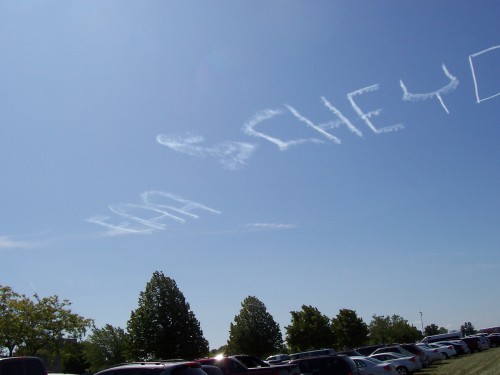
En route to this morning’s interview, I spotted a skywriter carefully working the skies over Oshkosh. First, they wrote “EAA” (Experimental Aviation Association, the group holding this event). Then, “S…C…H…E..Y…D…” Whaaa? Then, they followed this up with some distinctively phallic design. I would have a picture of this, but my batteries died right then. So many jokes I could make right there…
At any rate, today I interviewed Jessica Cox and Milton Buls (pronounced “Bulls”). I intended to take photos of all my victims…er, interview subjects…this year, but I haven’t been diligent in getting photos of everyone. I did manage to get photos of Colonel Milton Buls, however.
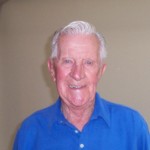
Colonel Buls was one of those terrific interviews where you sit down with someone who did incredible things…and yet escaped notice by historians. I found myself on a wild ride, a fabulous story never heard by anyone except for the participants before the interview. His son and grandson both sat in on the interview. His son retired from the Air Force and Fedex, and his grandson just passed pilot training with the Air Force, so I had three generations of Air Force in one room!
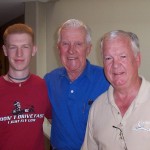 Colonel Buls fascination with flight began as a small child. He grew up in the middle of a large flat cornfield known as Kansas. One day, an aeroplane appeared in the sky…this was a big deal then. Heck, just a few years ago, there were only two cars in Kansas, and they had crashed into each other.
This was the first time Buls had seen a plane. It circled the farmhouse lazily, and then settled down in the back field.*
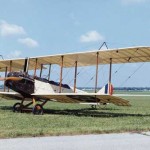 It was a Curtiss JN-4D Jenny, fresh out of the crate, still in olive drab military colors. At the stick was his uncle, a WWI airplane pilot. He had purchased the plane new from some depot (along with a fellow named Charlie Lindbergh) and was planning to join a flying circus and barnstorm around the country. He stayed over for a couple of days, and Buls remembered flying in the plane. He was supposed to sit on his father’s lap, but stood the entire time, his little hands gripping onto the top wing, a big grin on his face.
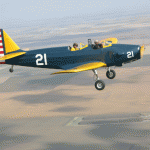 A number of years later, still enamored with airplanes, Buls joined an Army program. He didn’t expect to ever fly. Too expensive. Something for college graduates, people with money and connections. Instead, he was going to be a ground pounder. But when Pearl Harbor happened, everything changed. Suddenly, the thought of having an enlisted man become a pilot was no longer forbidden. Buls wrangled a switch to the Air Corps (this was before we had a separate Air Force), and just two months later, he was learning to fly in PT-19s.
It was a measure of the urgency of the war that Buls soloed in a mere 8 hours. His training moved fast, but it was subject to the whims of the military. Essentially, the military works like this: they need someone to do a job, you request to do that job, and some bored sergeant in HQ transfers you wherever he damned well pleases. In Buls case, within sight of becoming a fighter pilot, he found himself in Air Transport Command.
He was crushed. He wanted to be a hotshot fighter pilot, or even a bomber pilot. Let’s face it, they got the gals…and almost as important to Buls, they often had great golf courses at their bases. Well, a man’s got to have a hobby, right?
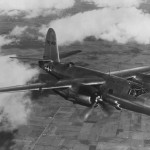 But Buls soon found ferrying bombers and cargo aircraft had its own set of challenges. His favorite plane was the Martin B-26 Marauder. This plane was a medium bomber with very advanced aerodynamics. The resulting plane was an extremely fast, efficient aircraft with a shoulder-mounted laminar-flow wing, all flush riveted, slim and sleek as a twin-engined shark.
Faster planes mean the pilots have to think a little faster themselves. In the middle of the war, with pilots being stamped from civilians at record rates, getting up to speed could be a problem. The faster landing speed, and unusual handling characteristics when an engine went out, caused quite a few accidents when the B-26 first came into service. The plane was dubbed “The Widowmaker”; ironically, the B-26 ended the war with the lowest accidental loss rate of any of the bombers…it just took time for people to get up to speed.
Buls got up to speed faster than anyone else, however. He trained at the Martin plant and soon learned to do things with the B-26 others considered impossible. He found himself training pilots everywhere on the idiosyncrasies of the aircraft…and probably saved countless lives in the process.
For this, he was rewarded with a transfer to India flying the hump with B-24 Liberators, C-46 Commandos, and B-25s converted to cargo craft (that bored sergeant in HQ struck again). Buls’ primary mission was shuttling aviation gasoline to remote airstrips in China. Think of it, flying aircraft with two-three thousand gallons of gasoline night and day in rotten weather without radios, lousy navigation, and all of this over some of the highest mountains and most rugged terrain in the world.
Buls soon discovered the electrical motor responsible for the landing gear hydraulic operations had a fatal flaw: it threw sparks when it ran. With an aircraft full of tanks bolted together, gas was bound to leak…so the crews were ordered to avoid using their landing gear if there was any hint of gasoline fumes in the cargo hold.
Shortly thereafter, the dangers of this were reinforced. Taking off for a night mission, Buls was following his best friend off the runway. His wheels had just left the ground, his friend’s plane was just starting to climb up…when it exploded into a massive fireball which lit the sky like a midnight sun. Buls had no choice but to fly right through the explosion and carry on his mission.
Buls had a close encounter a few weeks later. Coming in for a landing, his navigator checked the hold for fumes. He came rushing back. The gasoline was leaking badly, and there was 6 inches of gasoline sloshing around in the hold.
On the B-24, this wouldn’t have been a problem. The B-24 was originally designed as a bomber with humongous bomb bay doors. If this had happened there, he would have simply opened the doors and let the fuel out. But this night, Buls was flying a B-25 converted to carry cargo. Some unknown idiot had decided to weld the bay doors shut. As a result, they now had gasoline-filled swimming pool in their plane…and no means of dumping it.
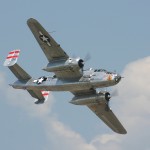
B-25 (Armed Version, but you get the idea...)
After the war, Buls found himself in unusual circumstances once again. Hoping to be transferred to a B-47 wing, he found himself in the newly formed ballistic missile command (bored sergeant strikes again). Buls picked the locations for bases, wrote the procedures for firing the missiles…that whole “two guys insert their keys and turn them” procedure? His. Oh, and this is the guy who decided to create Cheyenne Mountain. Yep, thanks to Buls, the military had a place to investigate the Stargate!
Another mix-up put Buls in charge of operations in Bolivia a few years after that…just after Che Guevara decided to make it his headquarters for converting the entire continent to Communism. Wow, remember that? What a blast from the past.
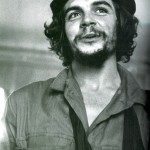
Buls was approached by the new President of Bolivia (#53 in a mere fifty-four years!) for a little help. They affixed guns to some AT-6s, a couple of Mustangs, and a venerable old C-47, and went hunting for Che’s jungle hideout.
Within days, it was all over. One of Buls’ AT-6s wounded Che, and he was brought in to face the firing squad. Realize, all of this time, Buls is still in Air Transport!
Eventually, Buls retired. He soon found himself working with a start-up that was to become Fedex. He flew with Fedex for 10 years, watching the company move from one plane to dozens. This was aided by an old friend he used to deliver Kentucky bourbon to, a certain Barry Goldwater. Eventually, he retired again, and starting building and flying airplanes for fun. Whew!
I spend two hours with Buls, and we could’ve spent days. It was most gratifying to hear his family say they had never heard most of these stories before.
 At the end of the day, Tracy and I interviewed another person, Jessica Cox, a young woman who had just flown into Oshkosh for the first time. While this is impressive in itself, it’s even more impressive when you know she did this only using her feet since she was born without arms.
The interview was rather short since she had another appointment, but quite fun anyhow. We talked about her choice of aircraft, the Ercoupe. As WWII was coming to a close, people expected there to be a boom in postwar aircraft sales. Ads talked about a helicopter in every garage, and magazines like Popular Mechanics wrote about the many designers working to create simple, “fool-proof” aircraft anyone could fly.
The Ercoupe was one of the most popular entries in this market (indeed, it’s had a couple of reincarnations). A single-engined low-wing monoplane with twin tails and a side-by-side seating under a bubble canopy, the plane was sleek and modern.
 The prospective pilot who sat in the plane soon realized an important difference separated the Ercoupe from other aircraft: no rudder pedals. Your feet did nothing. There wasn’t even a stick. It was a steering wheel, just like a car. This design included special features which tied the operations of the rudder and ailerons together. Additionally, the stabilizer had a limited range of movement. Combined together, the plane was not only simple to fly, but spin-resistant.
With Jessica, the Ercoupe was perfect. Her feet function as her hands. Operating the Ercoupe would be just like driving her car, and there would be no need for any costly modifications. She did all of her training in her beloved Ercoupe, including soloing, that first hard-landing, cross-country flights, and finally, traveling to Oshkosh with a “gaggle of Ercoupes”.
I asked Jessica if she was going to pursue more advanced training (e.g., an instrument rating), and she replied in the affirmative. She wants to become a flight instructor, and is even working with a young man who is, like her, also reliant upon his feet.
All-in-all, two terrific people to interview!
*I remember, as an airplane-mad kid, I was convinced that if a plane landed on our farm, it was ours! While we had lots of low-flying airplanes, we never had any landings (I came close to getting a National Guard helicopter once that came down to within 10′ of the ground!).



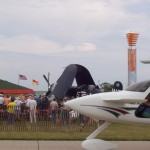
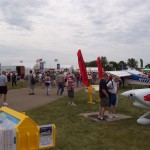
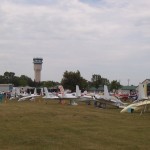
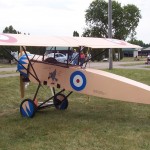
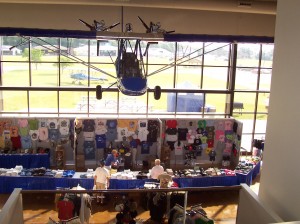 Crawled out of bed this morning, and we proceeded in the Museum to meet up with Zach (this is a view from the top of the stairs looking at the original AirCam and the t-shirt sales!). I’m not a morning person by any stretch of the imagination (my systems don’t really come online until mid-afternoon), but somehow, I’m able to get my rear in gear when there’s planes involved.
 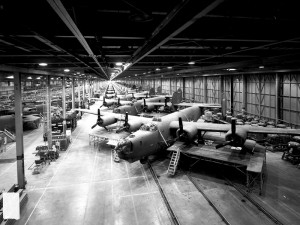 There were several volunteers at the tent (and Zach’s intern, a girl totally bored by aircraft), and no interviews yet. I listened to one of the Warbird’s…Warbirds are the former military aircraft brought to Oshkosh by private collectors…people talk about the difficulties of doing restoration work. Not on his aircraft, but his tug, a vehicle which tows airplanes around on the ground. He’s restoring a Ford-Ferguson tug used at the famous Willow Run factory. This was a factory created by Henry Ford to build aircraft on an assembly line much as he made cars. Raw materials entered the massive Willow Run facility on one end, and four-engined B-24 Liberator bombers rolled off on the other end.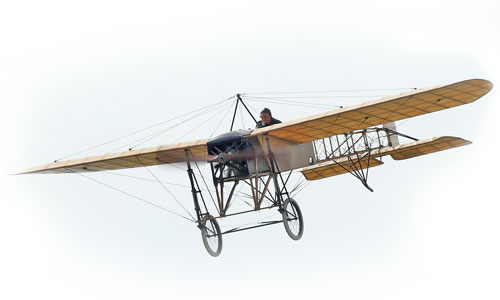
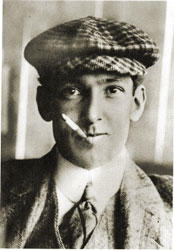 Hugh Latham decided he would give it a try first. Always a daredevil, Latham had tried his hand at speedboat racing and even wrangled a hot air balloon across the Channel in 1905. At night! Napoleon would have been proud; not only had he once considered the same, but Latham was French by birth. This time, however, was a more serious matter; his physician had advised him that he had but months to live. Never one to go gently into that good night, Latham decided he would rather go out with a bang. When a friend told him aviation was a dangerous sport fit only for the suicidal, Latham learned to fly.
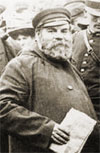 A friendship with a genial French engineer named Léon Levavasseur led Latham to select the elegant Antoinette monoplane as his mount (the series of aircraft took their name from the daughter of an industrialist backing the enterprise). The Antoinette series reflected Levavsseur’s philosophy, an solidly-engineered aircraft which eschewed the then-common wing-warping control technique in favor of true ailerons. The result was a stiffer wing and faster response. The surfaces themselves were moved by cables connected to a wheel and geared mechanism, allowing easy control no matter the breeze.
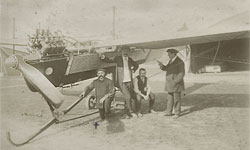 The Antoinette had a streamlined forward fuselage shaped like a boat (seen in this photo of a Russian-owned model). Latham reckoned this would come in handy in the event of a forced water landing. And indeed, it did serve that purpose well.
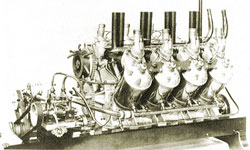 The lightweight engine coaxed 45 horsepower from around 7.2 litres of displacement. The design used a simplified crankshaft which let two opposing pairs of pistons share the same wrist pin. As a result, the crankshaft was both shorter (minimizing vibration issues at speed), and lighter. Levavasseur also had developed a simple fuel injection system that fed the cylinders equally and proved an excellent fuel-air mixture in theory; in practice, however, it proved extremely sensitive to the slightest contamination…dirt, a small bug, or other detritus.
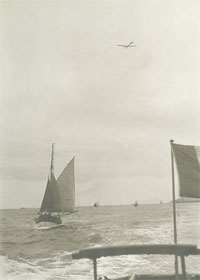 On July 19, 1909, Hubert Latham set out from Calais before dawn, with beautiful weather and a slight tailwind. Already favored by the odds-makers as the man to win, victory seemed firmly in his sight. All along the route, ships from both the French and British navies, as well as work and pleasure boats waited for Latham, waving at the tiny monoplane as it passed overhead. Ah, life was good!
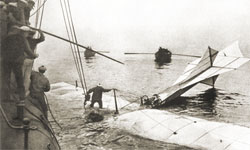 Six miles from his destination, Hubert Latham earned the dubious honor of making the first landing at sea. When picked up by a spotter boat, Hugh was sitting high and dry in the boat-like fuselage, smoking a cigarette with studied insouciance. The unusually-shaped fuselage had done its work well; there was minimal damage. At least, until the recovery crew tried to bring the airplane on-board, and nearly destroyed it. By the time the damage had been repaired so Latham could attempt his second flight, another challenger had appeared.
 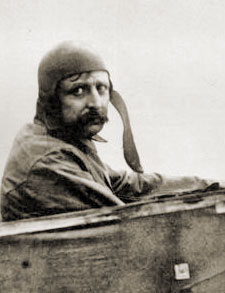 Louis Blériot was an old hand at aviation by this time. As careful and studied as Latham was bold and dashing, Blériot was already an established pilot and aircraft manufacturer.
 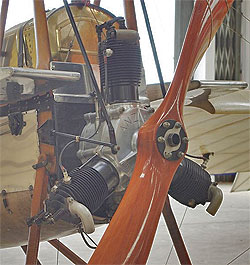 Unlike the complex, water-cooled V-8 which powered Latham’s Antoinette, Blériot chose a radial engine, a 3-cylinder Anzani which had the cylinders arranged like the petals of a flower, each one finned for maximum cooling.
 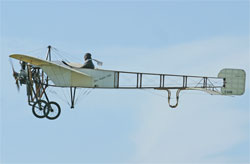 He was off and running. Time, 4:33 am. Weather fine. Blériot leveled off at 250 feet (76 metres…he was French, after all), and started flying at a steady 40 mph. A French destroyer below him provided escort. Then, the fickle Channel weather began to act up, tossing the fragile monoplane with the translucent wings about. The Channel waves turned into whitecaps, and rain began to fall.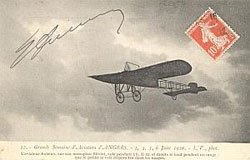
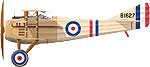 Blériot would become famous, an influential aircraft designer and manufacturer, responsible for the famous SPAD fighters used during WWI (see right). On May 21, 1927, Blériot would shake hands with a tired Charles Lindbergh, also worried about the aircraft he had just landed on a muddy Le Bourget field in Paris.
 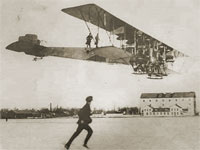 July 25 marked the end of an era for Britain. No longer was she an island. The age of the airplane had officially dawned. Few could doubt the usefulness of these tiny craft now. Within a couple of years, Igor Sikosky, father of the helicopter, would construct airliners complete with open air promenades and walnut paneled smoking lounges (see left), while others would drop the first bombs from aircraft in Turkey. In 1914, the dawn of WWI would end Britain’s illusory protection once and for all as both Zeppelins and aircraft attacked.